When Invoice Volume Grows Faster Than the Team Can Keep Up
The accounts payable process appears deceptively manageable on paper. A vendor emails a PDF. A member of the finance team downloads it, verifies the vendor details, keys the data into the accounting system, validates the GST, and registers a bill. At low volumes, this holds.
At 50 invoices a month, a diligent accountant can carefully enter the data without making any errors. But when the quantum of invoices grows to 500 to 1,000 in a month, you would end up deploying an army of accountants, and multiple people with different levels of experience are going to make data entry errors. This is precisely what happened at our company, Code Walnut.
Our founder, Ajay, would be sitting in a finance meeting with the finance manager, and when he has made a fabulous MIS and presenting the numbers, Ajay would call out some data that appears to be an error, and when you root cause it, you'll find, we found several invoices had errors in entry. Now, this puts the finance manager in the back foot. And he cannot confidently declare that he has insights into the financial health of the company. So this happened more than once and became a frustrating experience for the accounts manager, who could not necessarily rely on a set of account entry staff who are constantly using the revolving door. People were joining and leaving.
The process fails in two specific ways at scale:
- Data Entry Errors: Manual processing leads to errors such as incorrect ledger assignments, transposed values (e.g., a 20,000 invoice entered as 2,000), and duplicate registrations when multiple people work from a shared inbox.
- Lack of Real-Time Management Information: Backlogs of unprocessed invoices result in management reports being based on incomplete or dated financial data, preventing leadership from achieving the real-time MIS visibility they require.
The decision to build was forced by a single incident: The CEO requested to see supporting invoices for a few transactions under question. After fifteen minutes of searching through email threads, inbox folders, and shared drives, several originals still could not be located. The reports had not simply become occasionally unreliable. The data had become untrustworthy.
It was time to build a reliable Accounts Payable Systems.
Before walking through the solution, three questions tend to arise in every conversation about automating financial workflows of this kind:
What will this cost?
The answer depends on infrastructure choices, existing software subscriptions, and the volume of invoices in play. A detailed breakdown is covered in the architecture section.
How secure is the financial data?
Security is built into the design of the system, not added on top of it. The specifics are addressed in the non-functional requirements section.
How do we know it is actually working?
Two dedicated dashboards track system health and business performance in real time. Every number reported is derived from actual transactions processed, with intervention rates, processing times, and error trends all visible as they happen.
A System that combines AI, Rules and Human Expertise
The approach separates concerns clearly: AI handles extraction, deterministic rules handle business logic, and human reviewers handle anything the system cannot resolve with confidence.
Ledger assignment, GST validation, and vendor mapping are handled entirely in rules-based code. The model reads; the rules decide. Where the system cannot extract a required field cleanly, or where a validation check fails, the invoice is routed to a quarantine queue for human review before anything is committed to the accounting system. This is a designed feature, not a workaround, and it is how the system maintains accuracy while continuing to improve.
The result: volume processing handled automatically, and finance expertise reserved for cases that genuinely require human judgement.
System Architecture

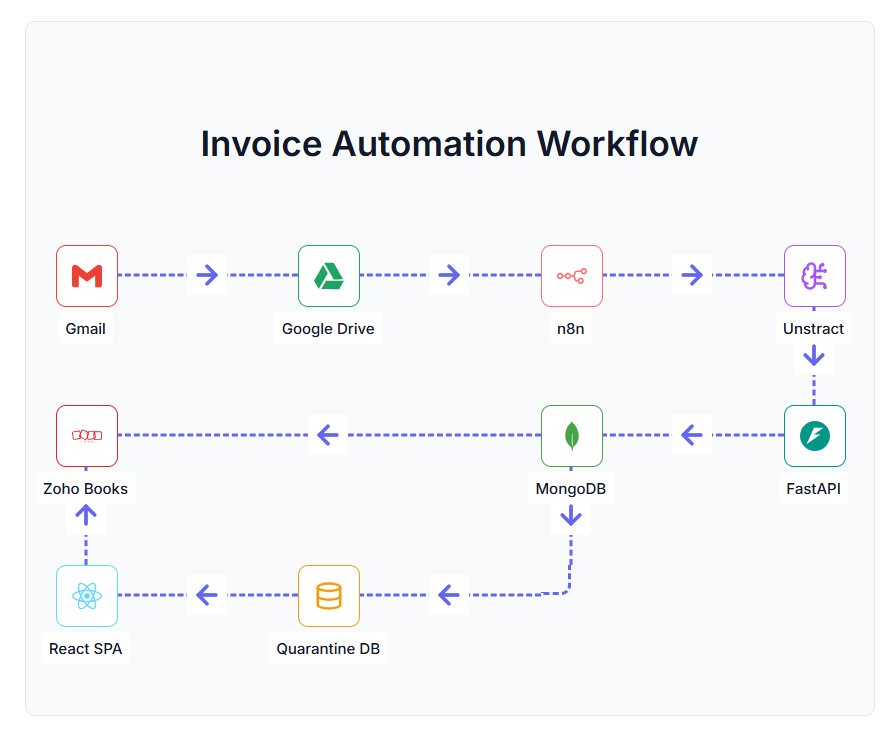
The platform is built across five layers, each with a clearly defined responsibility.
Ingestion : Workflow Orchestration on a Self-Hosted Server
An email trigger monitors the shared vendor inbox. When a message arrives, every attachment is enumerated and each invoice PDF is passed to the OCR engine, which converts it to structured JSON. A normalisation step standardises the output before moving downstream.
Two architectural decisions proved consequential here. First, every attachment in every email is processed independently, because vendors routinely send multiple invoices in a single message and each must be handled as a separate transaction. Second, the raw invoice file is saved to cloud storage before any processing begins, before OCR, before the application layer, before the accounting system. If everything downstream fails, the original document is preserved.
Application Layer : Business Logic and Validation
Parsed data arrives at the application service, which handles two distinct functions. Token management governs the full authentication lifecycle with the accounting system, including automatic rotation, retry logic, and silent re-authentication when a session expires mid-run. The invoice controller runs the business logic: validation against the vendor master, GST-to-vendor mapping, ledger assignment, duplicate detection via idempotency keys, and exception routing.
No business decisions are delegated to the AI model. One GST number maps to exactly one vendor. If that mapping fails, the invoice is quarantined.
Database Layer : Persistent Buffer
Every validated invoice is written to the database before any sync to the accounting system is attempted. When the accounting platform is unavailable, data sits safely in the buffer and syncs once the connection is restored. Nothing is lost in transit.
Review Interface : Finance Team Dashboard
Quarantined invoices are presented to the accounting team alongside the original document and the extraction output, side by side, so the reviewer can see precisely what was captured and correct it before the record is committed. The same interface surfaces the usage metrics needed to track system performance over time.
Accounting Integration
Validated invoices sync via API. Vendor resolution, bill creation, ledger assignment, and tax capture are all handled programmatically.
Non-Functional Requirements
The non-functional requirements for any financial data processing system must include the following four aspects:
- Cost Efficiency: The system should be cost-effective to operate, with optimized infrastructure and processing costs.
- Security: The system must provide strong security controls to protect sensitive financial data, including encryption, access control, and compliance with relevant standards.
- Reliability: The system must process financial data consistently and reliably, ensuring high availability and fault tolerance.
- Observability & Visibility: The system should provide comprehensive monitoring and visibility into processing health, including alerts, quarantine handling, error tracking, and operational dashboards to enable timely issue detection and resolution.
Cost
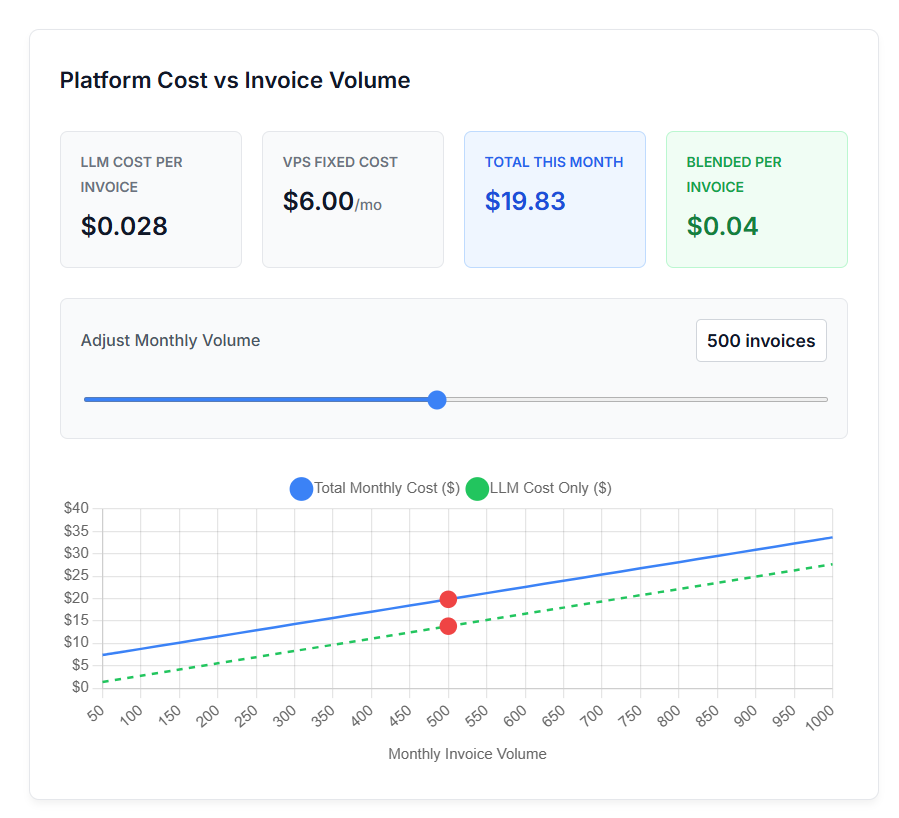
The two questions raised at the outset deserve direct answers here.
On cost: The platform costs very little to run at any realistic invoice volume. Infrastructure runs on a DigitalOcean VPS at $6 a month. AI extraction, based on actual usage data, works out to roughly $0.028 per invoice for the LLM tokens. Unstract plan can be separately managed with $99/month for 60,000 pages, which gives $0.1 per page.
No per-invoice SaaS fees. No automation middleware subscriptions. No additional Zoho costs, Zoho Books was already part of the team's existing stack before the project began. The primary cost is setup, integration, and ongoing maintenance.
Security
The manual process carried significant exposure. Invoices forwarded through open email threads, downloaded to personal machines, entered by staff with broad system access. Each of those is a risk surface.
The automated system narrows that surface considerably. Tokens rotate hourly and refresh automatically. Access is role-based, staff see only what the function requires. All communication is encrypted in transit. Every invoice carries an immutable audit trail: when it arrived, what was extracted, what was amended, when it was booked. Fewer touch points. Narrower access. Complete traceability.
Reliability
External services fail, and data extraction is inherently probabilistic. The system is designed with these assumptions built in from the start.
To ensure data accuracy, strict guideline rules are enforced, and raw data extracted via OCR undergoes a rigorous double LLM verification process. This multi-layered validation ensures that no hallucinated or incorrect values make it into the accounting system.
Furthermore, the database buffers all data before any accounting sync is attempted, so downtime in the accounting platform does not cause data loss. Authentication management handles token expiry transparently, intercepting the failure, refreshing credentials, and retrying without manual intervention. Network timeouts trigger automatic retries with exponential backoff. Idempotency keys at ingestion ensure the same invoice cannot enter the system twice, regardless of how many times a vendor submits it.
An invoice that enters this system does not disappear, and its data is systematically verified.
Observability

Visibility into performance is split into two views, because the people looking at them are asking fundamentally different questions.
System health metrics are monitored by the engineering team: API uptime, error rates, retry counts, queue depth, and failed job logs. This view exists to surface problems before anyone else notices them.
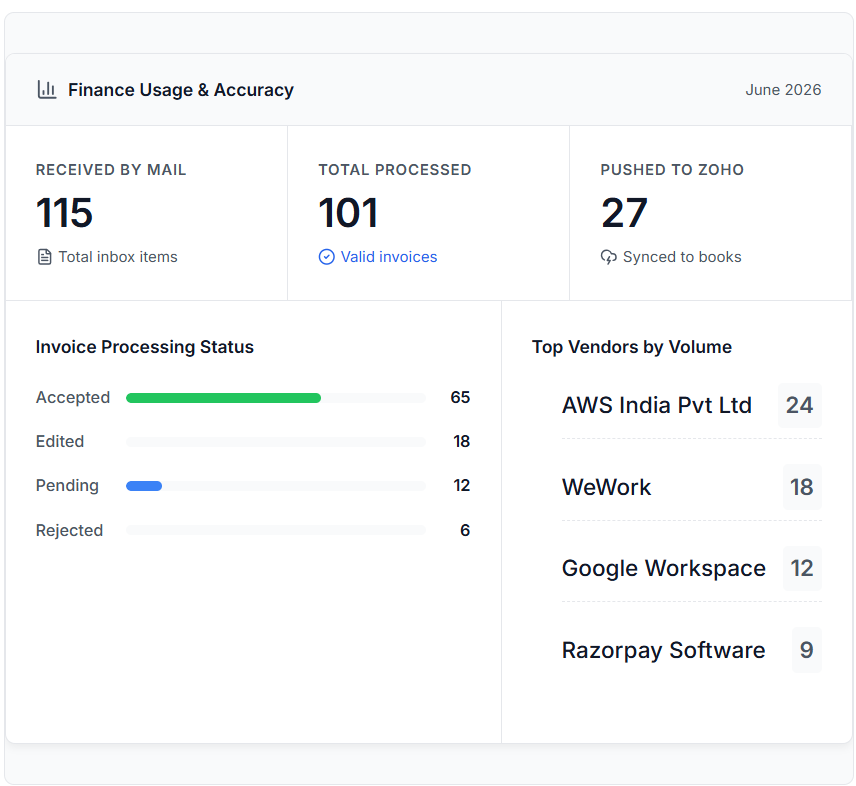
Usage metrics are monitored by finance leadership: invoice volume processed, average processing time, human intervention rate, and how that rate trends over time. In the early months of operation, roughly 50% of invoices required some form of human correction. At steady state, that figure sits below 5%. In one recent month, 89 of 94 invoices were processed without any intervention. Five were quarantined for review. That trend is visible in the dashboard, measured in real time.
Outcomes
Hurdles and Challenges we overcame
While we anticipated many of the situations, deploying this application revealed many edge cases. And within a matter of two weeks, we were able to discover all the important edge cases and address them effectively. I am sharing those challenges below.
1. Undocumented API endpoints in the accounting system
Standard API documentation covered routine invoice operations but did not document the endpoints required for TDS capture. After exhausting the documentation, a direct escalation to Zoho support yielded the required endpoint. The integration then proceeded correctly, but this consumed a week of unplanned effort.
For any organisation building on a third-party accounting platform in the Indian market: TDS is not an edge case. It is a compliance requirement. Time for a support escalation should be built into the integration plan from the start.
2. Invoices missing quantity and rate breakdowns
Some vendors state only a total without separating component fields. The model, finding nothing to extract, returned zero for quantity and rate. The system treated these invoices as successfully processed; incorrect figures were already in the books before the pattern was caught.
The fix was a validation gate: any line item on an invoice with a non-zero total that carries a zero or null quantity or rate is quarantined before any write occurs. A human reviewer supplies the correct values. The system does not estimate numerals.
3. Multiple invoices in a single email
The initial ingestion logic assumed one email contained one invoice. When a vendor began sending three invoices as separate attachments in a single message, the system processed the first and silently ignored the rest. The ingestion layer was rearchitected to enumerate all attachments independently and create a separate processing job for each.
4. Vendor identity mismatches
For vendors without GST registration, the model occasionally matched invoice fields to the wrong vendor record, typically due to similar names or overlapping address data. Explicit GST-to-vendor mapping was enforced in the validation layer. Where GST registration is absent, identity is verified against PAN and registered address before the invoice proceeds.
5. Duplicate submissions
Vendors resend invoices. Emails get forwarded. Documents get resubmitted accidentally. An idempotency key is now assigned to every invoice at ingestion. The same invoice cannot enter the system twice, regardless of how many times it arrives.
6. Implicit Line Item Structure
Some invoices state a total without separating it into quantity and rate. Rather than attempting to decompose fields that are not present, the system detects this pattern and treats the line as a single amount, routing it cleanly through the pipeline.
7. Unregistered Vendors
Standard validation requires a GSTIN on every invoice. For vendors operating without GST registration, a separate processing pathway handles identity verification through PAN, bank account details, or registered address before the invoice proceeds.
8. Non-Standard Invoice Formats
The system can also handle non-standard invoice formats, such as heavily stylised invoices or those carrying non-English text, through proper OCR and double LLM verification to ensure extraction accuracy before committing to the books.
Principles That Guided the Build
Persist before processing. Save the raw document the moment it arrives. Everything downstream can be retried. The original cannot be recreated.
Extract with AI; decide with rules. Language models read unstructured documents well. Ledger assignments and vendor decisions belong in deterministic, auditable code.
Quarantine is a feature, not a fallback. Human review of flagged invoices is how accuracy is maintained while the system matures, and how the signal is built to improve validation over time.
Third-party documentation has gaps. Especially for domain-specific compliance requirements. These need to be identified early and escalated before they become timeline problems.
Two dashboards, two stakeholders. System health and business performance are different concerns and need separate views built for the people who act on each.
Where This Leads
The platform now handles 90% of vendor invoices end-to-end without manual effort. The remaining 10% pass through a human approval stage, not as a system limitation, but as a designed checkpoint for invoices that benefit from a final review before being committed.
Finance leadership no longer walks into an MIS review uncertain about the numbers. Supporting invoices for any transaction are retrievable in seconds, not minutes.
With the invoice pipeline stable, the same architecture is being extended to credit card payment automation and employee reimbursement processing. The underlying approach remains unchanged: AI for extraction, rules for validation, humans for genuine exceptions.
The goal was never to remove people from the process. The goal was to remove the drudgery, so that financial expertise can be directed toward the decisions that actually require it.



 When to Hire CodeWalnut?


