Best 5 AI Code Review Tools: Complete Comparison with Real Data
A comprehensive, evidence-based comparison of the top 5 AI code review tools in 2025 - analyzing pricing, security compliance, user reviews, case studies with hard ROI numbers, and integration ecosystems to help engineering teams choose the right tool for their specific needs.
The promise of AI in software development has shifted. In 2023, it was about generating code. In 2025, the battleground is reviewing it.
For Engineering VPs and Senior Devs, the problem isn’t "Can AI read code?" it’s "Can it actually reduce cycle time without flooding my team with noise?"
We evaluated them on 10+ dimensions that actually matter to decision-makers, including SOC2 compliance, "hidden" pricing costs, and specific innovation speeds.
Here is the unvarnished truth about the state of AI code review.
CodeRabbit: AI-Powered PR Efficiency

CodeRabbit is an AI-powered code review tool purpose-built for engineering teams working with GitHub or GitLab. It provides actionable, AI-driven feedback directly inside pull requests, helping teams catch bugs and improve code quality faster.
Ideal Customer Profile (ICP):
- Software engineering teams using GitHub/GitLab PR workflows
- Teams wanting to automate routine PR reviews (style, bugs, consistency)
- Organizations with 10-100 developers
Why It Works:
CodeRabbit reduced bugs by 30% and increased release velocity by 25% for SalesRabbit, shortening review cycles from days to hours.
Not Suitable for:
- Teams needing deep security scanning (SAST, IaC, supply-chain). Tools like Aikido or CodeAnt offer broader AppSec coverage.
- Organizations requiring self-hosted, multi-VCS support beyond GitHub/GitLab.
Pricing Breakdown
Real Cost for 10 Developers: ~$1,440/year (Lite plan, annual billing)
The SSO Tax: Single Sign-On locked to Enterprise tier
Top Features (from G2 Reviews 2024-2025)
What Users Love:
- AI PR Reviewer - Catches subtle bugs, edge cases, and missing tests directly in pull requests
- PR Summaries with Diagrams - Helps reviewers understand complex changes faster
- Committable Suggested Fixes - Applied directly from review, reducing manual edits
Killer Feature: The AI-driven PR review workflow (summaries + inline findings + committable suggestions) is described by users as making it "hard to go back to manual-only reviews."
Biggest Complaints:
- Pricing: Too expensive for minor issue detection; unclear value at higher tiers
- Performance: LLM context limits on very large PRs (stops or fails)
- Noise: Many low-value comments making it hard to focus on important issues
Security & Compliance
Security Concern: The August 2025 RCE vulnerability is a red flag for security-sensitive teams.
Integrations & Ecosystem
Native Integrations: 2+ (primarily GitHub & GitLab)
Top Categories:
- DevOps Tools
- Git Repositories
- IDE Extensions
API Rate Limits: ~15 reviews/hour (varies by plan)
Webhooks: Yes
Notable Gaps: No Zapier integrations; heavily GitHub/GitLab focused
Performance & Reliability
Support Quality
Channels: Email, support ticket
Availability: Business hours
Customer Service Rating:
- ~9.1/10 (G2 Quality of Support)
- ~4.8/5 (G2 overall rating)
Help Center: https://docs.coderabbit.ai
Market Position & Funding
Founded: 2023
Headquarters: Walnut Creek, CA
Active Customers: 8000+ Paying Customers
Latest Funding: $16M Series A (August 2024)
- Led by: CRV
- Other investors: Engineering Capital, Flex Capital
Employee Count: 11-50
Update Frequency
Cadence: Monthly (4+ updates in last 3 months)
Latest Major Features (Last 90 Days):
- New custom report organization with org/team stats
- Bitbucket Cloud integration
- CircleCI pipeline failure detection
Public Roadmap: Private (not publicly available)
Changelog: https://docs.coderabbit.ai/changelog
Real Customer Results
Company: SalesRabbit
Problem: Needed to reduce bugs and improve velocity on legacy multi-language codebase
Results:
- Reduced bugs by 30%
- Increased release velocity by 25%
- Shortened review cycles from days to hours
Source: Case Study
- Are a GitHub-centric team of 10-100 developers
- Want to automate routine PR reviews (style, bugs, consistency)
- Need affordable entry at $12/user/month with unlimited repos on the free plan
- Value committable suggestions that reduce review back-and-forth
Avoid if: You need deep security scanning (SAST/IaC/SCA) or self-hosted, multi-VCS support.
Codacy: Enterprise-Grade Security Scanning
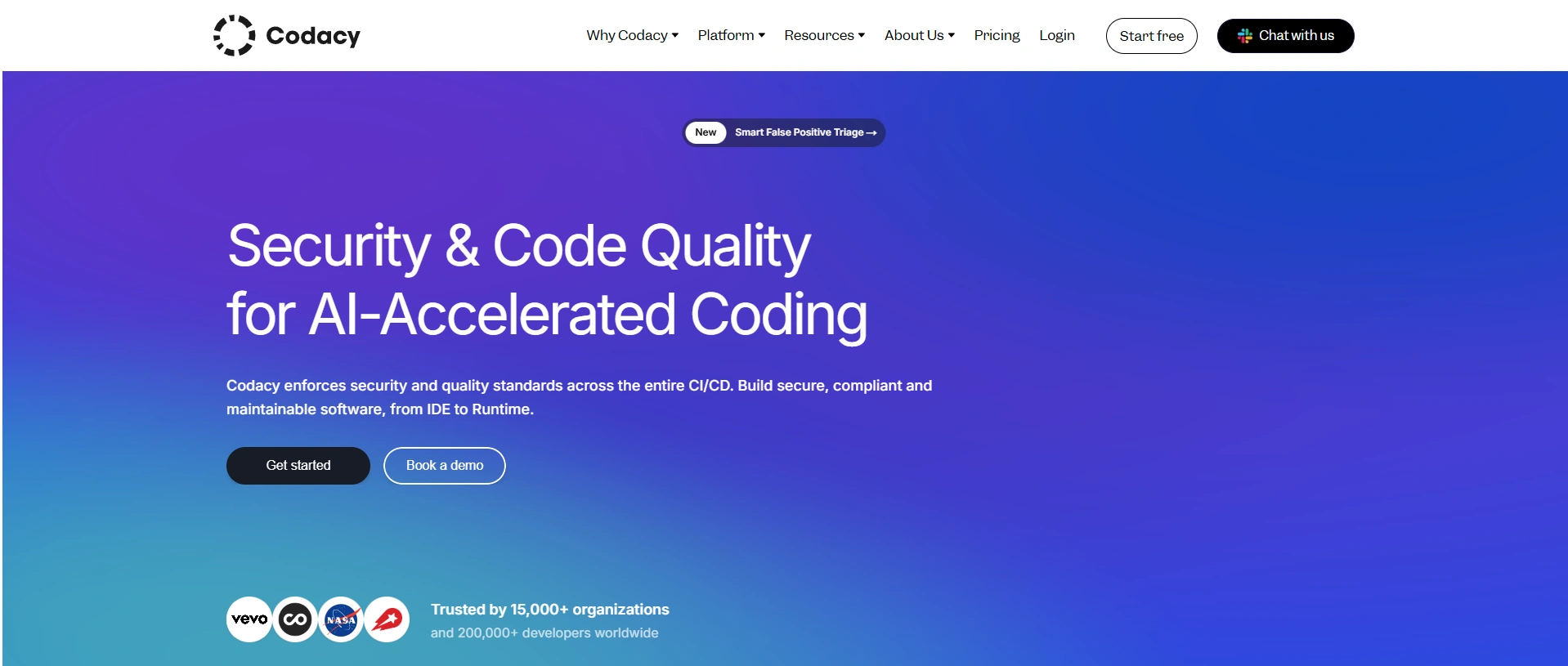
Codacy is an enterprise-focused automated code review platform with AI-enhanced static analysis, designed for compliance, metrics, and scalable policy enforcement across thousands of repos.
Ideal Customer Profile (ICP):
- Enterprise development teams prioritizing security
- Organizations managing 500+ repositories
- Teams needing SAST, SCA, and IaC scanning in one platform
Why It Works:
Codacy serves over 870 customer organizations and 300,000+ developers (source), saving O.C. Tanner up to 60% in development costs through faster issue detection across 500+ repos (case study).
Not Suitable for:
- Teams needing AI conversational review (chat-style reviewer). Greptile or CodeRabbit are better suited.
- Small teams finding the $15/user pricing steep for basic quality checks.
Pricing Breakdown
Real Cost for 10 Developers: ~$1,800/year (Pro plan, annual billing)
The SSO Tax: Available starting at Enterprise tier
Top Features (from G2 Reviews 2024-2025)
What Users Love:
- Integrated SAST, SCA, and IaC Scanning - Continuously flags vulnerabilities across projects
- Centralized Security Dashboard - Actionable metrics across repositories
- Tight CI/CD Integration - Scans run automatically on each commit/PR
Killer Feature: Combined code-security scanning (SAST + SCA + IaC) wired into CI/CD with unified dashboard is essential for day-to-day work.
Biggest Complaints:
- Performance: Slow or stuck analysis on large repositories
- UX: Overwhelming rule configuration with hundreds of rules to sort through
- Language Support: Gaps in library support (e.g., Lombok) leading to noisy findings
Security & Compliance
Integrations & Ecosystem
Native Integrations: 20+ major tools (Dev Tools, CI/CD, Security)
API Rate Limits: 2,500 requests per 5 minutes (per IP)
Webhooks: Yes
Community Support: Zapier integrations available
Performance & Reliability
Support Quality
Channels:
- Email/in-app chat (Pro+)
- Priority support with screen sharing (Business+)
- Phone support (Enterprise)
Availability: Business hours
Customer Service Rating:
Help Center: https://docs.codacy.com
Market Position & Funding
Founded: 2012
Headquarters: Lisbon, Portugal
Active Customers: 105 companies, 9687 Developers
Latest Funding: No new rounds 2023-2025 (Series B in prior years)
- Key investors: EQT Ventures, Armilar Venture Partners
Employee Count: 51-200
Update Frequency
Cadence: Monthly (multiple cloud releases June-Oct 2025)
Latest Major Features (Last 90 Days):
- Severity gates for security issues
- Segment filtering for standards
- API token expiration support
Public Roadmap: Private
Changelog: https://docs.codacy.com/release-notes/
Real Customer Results
Company: O.C. Tanner
Problem: Maintaining code quality and reducing development costs across distributed teams
Results:
- Saved up to 60% in development costs
- Faster issue detection across 500+ repositories
- Improved code consistency
Source: Customer Story
- Are an enterprise with 500+ repos needing security scanning
- Require SAST, SCA, and IaC scanning in one platform
- Have distributed teams maintaining code quality across large portfolios
- Can justify $18–$21/user/month for advanced DevSecOps coverage (see updated pricing).
Avoid if:
- You want conversational, AI-driven review experiences (try CodeRabbit or Greptile).
- Your team finds rule configuration or large-scale policy management overwhelming.
Code Climate: Engineering Intelligence & Metrics
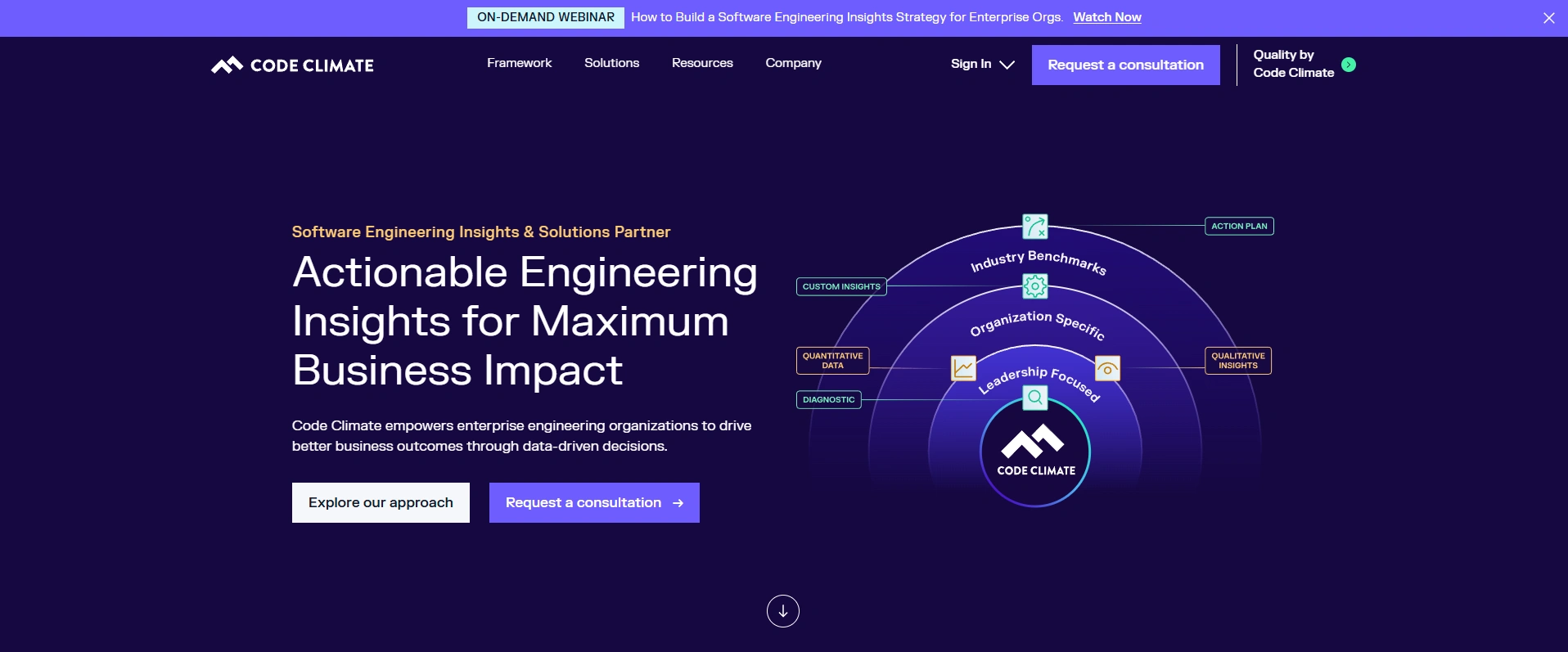
Code Climate provides automated static code analysis and engineering analytics for teams wanting metrics on code quality, velocity, and productivity. Its core focus is on maintainability scores, cycle times, and detailed reporting.
Ideal Customer Profile (ICP):
- Engineering managers and leaders wanting productivity analytics
- Organizations tracking DORA metrics and cycle time
- Teams consolidating data from multiple repositories
Why It Works:
Code Climate Velocity provides historical data consolidation, engineering metrics, and dashboards showing throughput, cycle time, and team performance across repos.
Not Suitable for:
- Cost-conscious mid-sized teams. Waydev highlights Code Climate's complex pricing and high per-engineer costs.
- Teams wanting flexible, frequent feature updates (slower evolution noted by competitors).
Pricing Breakdown
Real Cost for 10 Developers: ~$2,400/year (Quality plan, annual billing)
The SSO Tax: Available at Enterprise or custom plans
Top Features (from G2 Reviews 2024-2025)
What Users Love:
- Historical Data Consolidation - Pulls commit/PR data from multiple repos into single view
- Data Context & Metrics - Explains why delivery trends change and where bottlenecks occur
- Leadership Dashboards - Shows throughput, cycle time, team performance across repos
Killer Feature: End-to-end engineering performance visibility (Velocity dashboards combining historical repo data and delivery metrics).
Biggest Complaints:
- Pricing: Per-engineer pricing and seat minimums expensive for mid-sized teams
- Performance: Data processing delays leading to out-of-date dashboards
- UX: Steep learning curve for configuring metrics; limited dashboard customization
Security & Compliance
Integrations & Ecosystem
Native Integrations: ~3 official
Top Categories:
- DevOps
- Issue Tracking
- Notifications
API Rate Limits: No explicit limits found
Webhooks: Yes
Third-Party Coverage: Extensive via Zapier/Make (~3,000 connectors)
Performance & Reliability
Support Quality
Channels: Community, Email, Phone (higher tiers)
Availability: Business hours
Customer Service Rating:
- ~8.5/10 (G2 Quality of Support)
- ~4.3/5 (G2 overall rating)
Help Center: https://docs.codeclimate.com/
Market Position & Funding
Founded: 2011
Headquarters: New York, NY
Active Users: 50,000 Developers
Latest Funding: No new rounds 2023-2025 (Series C in 2021)
- Key investor: Union Square Ventures
Employee Count: 11-50
Update Frequency
Cadence: Quarterly (3-4 releases in last 3 months in GitHub repos)
Latest Major Features (Last 90 Days):
- Migration to new test runner
- Transition to ESM-only module
- Improved CI release handling
Public Roadmap: Private
Changelog: https://github.com/paambaati/codeclimate-action/releases
Real Customer Results
Status: No quantitative case study available for 2023-2025
- Are an engineering leader tracking productivity metrics
- Need DORA metrics, cycle time, and throughput dashboards
- Want historical data consolidation across multiple repositories
- Require visibility into team performance and bottlenecks
Avoid if: Per-engineer pricing ($20/user/month) is too high or you need frequent feature updates.
SonarQube: Industry-Standard Quality Gates
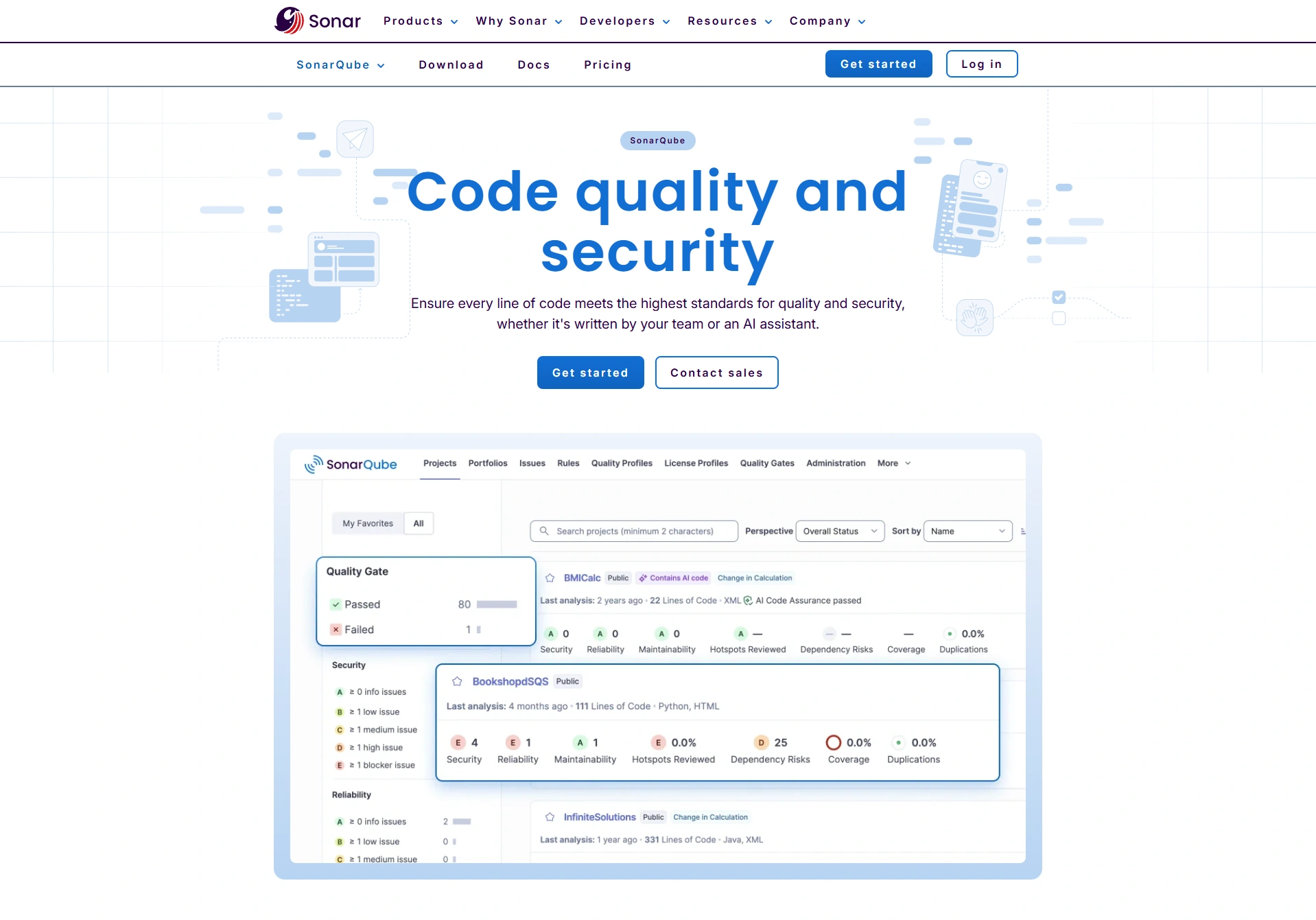
SonarQube is the market leader for deep static code analysis and security checking, designed for DevOps, QA, and security teams. It provides automated scanning for bugs, vulnerabilities, and code smells across dozens of languages.
- Ideal Customer Profile (ICP):
- DevOps/Platform teams running CI/CD at scale
- Security-conscious enterprises needing quality gates
- Organizations analyzing code in 25+ languages (SonarQube Languages)
- Why It Works:
- Used by over 7 million developers across hundreds of thousands of organizations (Grokipedia)
- Dunnhumby (Tesco) saved developers 5-10 hours/week, with ROI in first month (SonarSource Case Study)
- Not Suitable for:
- Teams wanting fast, low-maintenance SaaS or a modern UX (G2 reviews)
- Orgs needing all-in-one security (SAST, SCA, IaC, container) without extra tools
Pricing Breakdown
Cloud Plans
Self-Managed Plans
Real Cost for 10 Developers: ~$720/year (Developer Edition; LOC limits apply), may rise to $20,000+/year for Enterprise
The SSO Tax: Available at Enterprise/Data Center editions only
Top Features (from G2 Reviews, Capterra)
What Users Love:
- Deep static code analysis catching code smells, bugs, and vulnerabilities
- Quality gate enforcement directly in CI pipelines
- Rich dashboards with remediation guidance for technical debt
Killer Feature:
- Quality gates integrated into CI/CD that auto-block releases if code doesn’t meet standards (SonarQube Docs)
Biggest Complaints:
- Commercial editions pricey for small orgs
- Slow scans on large monorepos
- Dated and cluttered UI, complex configuration
Security & Compliance
Note: SonarQube is the only tool in this comparison explicitly documenting AES-256 encryption at rest.
Integrations & Ecosystem
Native Integrations: 100+ plugins (Marketplace)
Top Categories:
- Security
- Quality Analysis
- Dev Tools
API Rate Limits: No official global limits stated
Webhooks: Yes
Ecosystem: Mostly native plugins; no Zapier mentions
Performance & Reliability
Support Quality
- Channels: Community, email, phone/chat/video (Enterprise)
- Availability: Business hours
- Customer Service Rating: ~4.5/5 stars (G2 reviews)
- Help Center: SonarQube Docs
Market Position & Funding
Founded: 2008
Headquarters: Geneva, Switzerland
Latest Funding: $412M (April 2022)
- Led by: Advent International, General Catalyst
- Other investors: Insight Partners, Permira
Employee Count: Large organization (exact band not publicly visible)
Update Frequency
Cadence: Monthly (regular plugin and server releases)
Latest Major Features (Last 90 Days):
- Enhanced developer education features
- Deeper IDE learning integrations with SonarLint
Public Roadmap: Private (third-party courses available)
Changelog: Marketplace updates
Real Customer Results
Company: Dunnhumby (Tesco)
Problem: Automate code quality and issue detection to improve developer efficiency
Results:
- Developers saved 5-10 hours/week
- ROI realized within first month of implementation
Source: Customer Story
- Need industry-standard static analysis across 25+ languages
- Run CI/CD at scale with quality gates blocking bad code
- Are a security-conscious enterprise with complex compliance needs
- Can invest in setup and maintenance (self-hosted) or pay for managed cloud
Avoid if:
- You need a fast, easy-to-use SaaS or streamlined onboarding experience
- You want end-to-end DevSecOps (SAST, SCA, IaC, container) as a single package
Greptile: Codebase-Aware AI Review
Greptile is a security-first, AI-powered code review tool that analyzes entire codebases, not just PR changes, providing deep context and compliance for GitHub/GitLab teams.
Ideal Customer Profile (ICP):
- Software teams using GitHub/GitLab with large, complex codebases
- Security-sensitive enterprises needing SOC 2 compliance
- Teams wanting AI that understands entire repository context
Why It Works:
Greptile is the only SOC 2 Type II certified tool in this comparison. Raised $25M Series A (September 2025) from Benchmark, indicating strong market validation for codebase-aware AI.
Not Suitable for:
- Teams using Bitbucket, Azure DevOps (limited SCM support).
- Budget-conscious startups—at $30/user without a free tier, it's the most expensive entry point.
Pricing Breakdown
Real Cost for 10 Developers: ~$3,600/year (Standard plan, annual billing)
The SSO Tax: Included in Enterprise tier
Top Features (from Reviews & Write-ups 2024-2025)
What Users Love:
- Codebase-Aware AI - Builds internal understanding of large repos and uses context during reviews
- Contextual PR Review Comments - References related files/modules instead of only looking at diff
- Interactive Q&A - Developers can ask follow-up questions and get precise answers sourced from repo
Killer Feature: The codebase-aware AI reviewer that understands the entire repository and brings that context into every PR review and Q&A.
Biggest Complaints:
- Pricing: Per-seat pricing steep for early-stage teams; no free tier
- Performance: Latency when querying very large codebases; occasional misinterpretation of complex logic
- UX: Setup for enterprise/self-hosted deployments described as involved; limited SCM coverage (mainly GitHub, partial GitLab)
Security & Compliance
Key Insight: Only tool in this comparison with public SOC 2 Type II certification.
Integrations & Ecosystem
Native Integrations: Limited native
Top Categories:
- Dev Tools
- AI Agents
- Automation
API Rate Limits: No official limits found
Webhooks: Yes
Third-Party Coverage: Heavy reliance on Zapier for workflows beyond core
Performance & Reliability
Support Quality
Channels: Contact form, Email, Sales team
Availability: Business hours (not detailed publicly)
Customer Service Rating: No Capterra/Trustpilot ratings found
Help Center: https://docs.greptile.com (limited public docs)
Market Position & Funding
Founded: 2021
Headquarters: San Francisco, CA
Latest Funding:
- Seed: $4M (2024) - led by Initialized Capital, Y Combinator
- Series A: $25M (September 2025) - led by Benchmark at $180M valuation
Employee Count: 2-10
Update Frequency
Cadence: Sporadic (one significant update in last 3 months)
Latest Major Features (Last 90 Days):
- Greptile 2.0 major upgrade focused on scaling AI code validation capabilities
Public Roadmap: Private
Changelog: https://www.greptile.com/blog/greptile-2
Real Customer Results
Status: No publicly available quantitative case studies from 2023-2025
- Have large, complex codebases where context matters
- Are a security-sensitive enterprise needing SOC 2 Type II compliance
- Want codebase-aware AI that understands entire repository relationships
- Can afford $30/user/month with no free tier
Avoid if: You use Bitbucket/Azure DevOps, need budget-friendly options, or are a small startup.
Best Tool for Each Persona
Reason: Offers the most affordable entry tier at $12/user/month with a free plan that supports unlimited public and private repositories—ideal for smaller teams needing straightforward GitHub/GitLab integration.
Reason: Holds SOC 2 Type II compliance (unlike competitors) and offers self-hosting options, security features, and dedicated support tailored for secure enterprise environments.
Reason: Provides over 100 native plugins and deep static analysis integrated into IDEs and CI pipelines, with a widely recognized ecosystem and third-party certification programs enhancing developer productivity.
Reason: Balances feature richness—including SAST, SCA, and IaC scanning—with a moderate starting price and a free tier supporting 300,000+ developers, offering comprehensive security and quality checks integrated into CI/CD.
Get in touch - Our team has developed scalable solutions for enterprises and has a Crunch rating of 4.9⭐.


Experience coding prowess firsthand. Choose CodeWalnut to build a prototype within a week and make your choice with confidence.

Accelerate your web app vision with CodeWalnut. In just a week, we'll shape your idea into a polished prototype, powered by Vercel. Ready to make it real? Choose us with confidence!

Dreaming of a powerful web app on Heroku? Let CodeWalnut bring it to life in just one week. Take the leap and trust us to deliver with confidence!

Related topic
Draw Diagrams Using Agent Skills
Automate architecture, workflow, and system design diagrams using agent skills. Enable your AI agent to generate consistent, high-quality technical visuals directly from prompts, reducing manual effort and improving documentation speed.
React Coding Masterclass — Foundations Edition
Learn React best practices used by senior engineers. This React Coding Masterclass covers semantic HTML, naming conventions, declarative programming, architecture patterns, and SOLID principles for building clean, scalable React applications.
.webp)
How I Executed a Successful React Hiring Walk-in Campaign: From Zero to Three Hires in One Day
From zero to three hires in one day—here’s how a small brand cracked ‘walk-in hiring’ in a new city, won trust, and turned interviews into developer fan moments.


 When to Hire CodeWalnut?


